18 February 2026
Shadow AI: Why Your Staff Are Using ChatGPT (And The Risks)
Staff using public AI tools like ChatGPT for work tasks presents significant data leakage and GDPR risks for insurance brokers. We expose why your team might be doing it and how purpose-built AI platforms address these shadow AI concerns, keeping your client data secure.

The Secret Lives of Your Brokerage's Data
You've likely heard the buzz around AI. Your team has too. The challenge is, many public-facing AI tools are free, powerful, and easily accessible. They're designed to be helpful, to summarise, and to generate text quickly. For a busy broker or account handler, faced with a stack of policy wordings or a complex client email, the temptation is clear. Why spend 20 minutes drafting a response or summarising a dense document when ChatGPT can do it in seconds? So, to answer the question, 'Is ChatGPT safe for insurance brokers?', we need to delve deeper.
This isn't about malicious intent. It's often about efficiency. Your team needs to move fast, process information and serve clients. When they see a tool that promises to make their job easier, they'll use it. Especially if your current internal systems feel slow or cumbersome. That's the core of 'Shadow AI' in your office. It happens when staff bypass approved tools because, from their perspective, the unapproved tools simply get the job done faster.
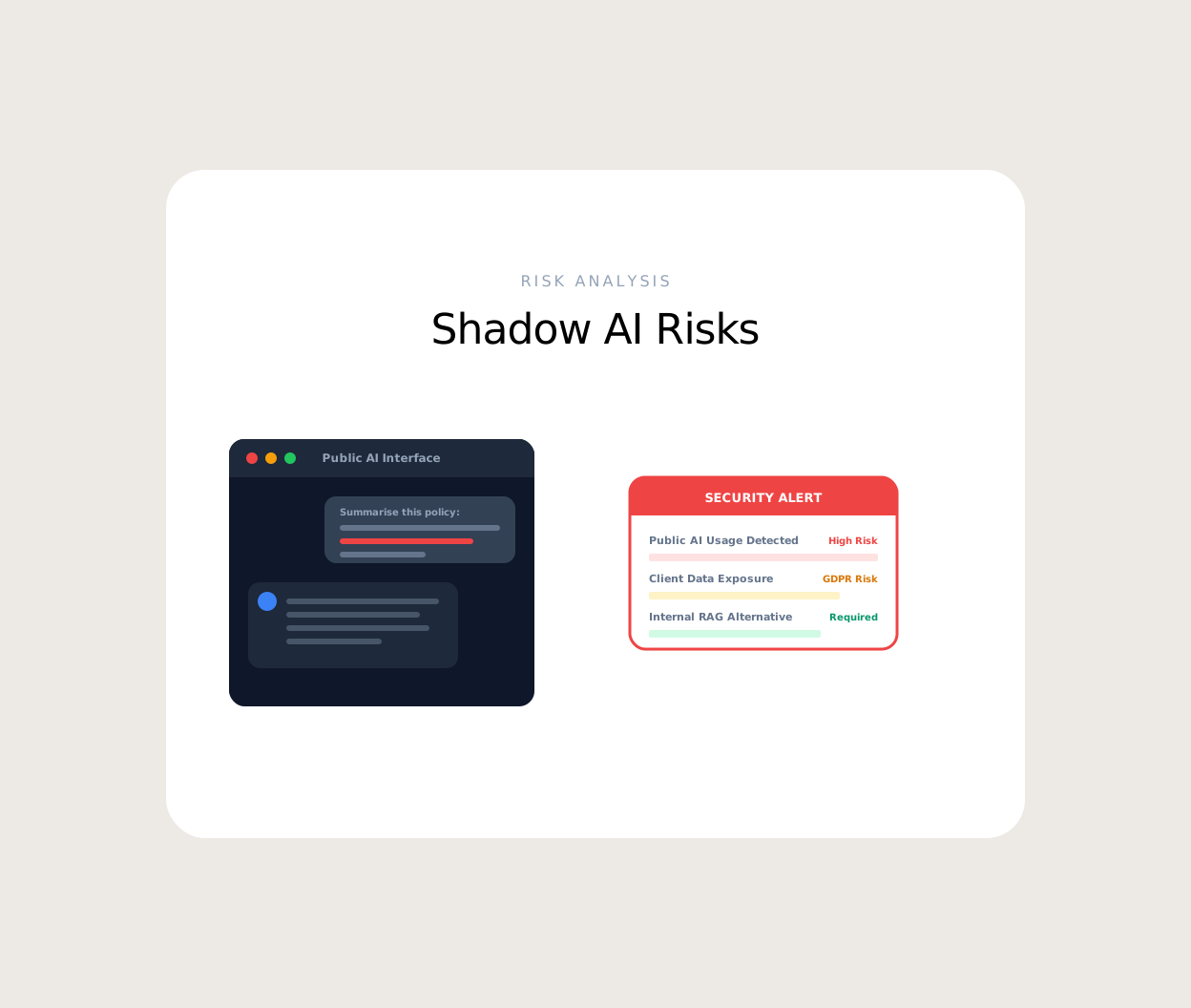
The problem, of course, is what happens to that client data once it leaves your secure environment. When your staff copy-paste policy details, client names, claim histories, or even just general policy terms into a public AI platform like OpenAI's ChatGPT, that data isn't yours anymore. It's often used to train the AI model, making it a serious data protection and E&O headache. Frankly, it's a compliance officer's worst nightmare. You need to address this, or face some potentially significant repercussions for regulatory compliance.
Understanding The 'Why' Behind Shadow AI in Brokerages and Generative AI for Insurance Compliance
Let's be direct. Your staff uses tools like ChatGPT because there's a perceived gap in their workflow. We've seen it across the market. Specific scenarios often highlight this:
Summarising complex documents: Imagine an account handler needing to quickly grasp the key points of a 40-page Commercial Combined schedule or a specific policy wording. Manually, that's a slow read. Public AI offers a quick summary. That's a strong pull.
Drafting client communications: Responding to a client query about exclusion clauses or policy coverage can be time-consuming to word just right. An AI assistant can draft an initial response very quickly.
Finding specific clauses: Rather than 'Ctrl+F' through a large PDF, often missing a nuance, some might try to ask a public AI to find relevant clauses. This runs the risk of data leakage, but it happens.
Each of these actions, while seemingly benign, is a potential information leak. Your client data, confidential policy terms, and proprietary information could be exposed to third parties, violating GDPR, company policy, and risking your firm's reputation. It also creates inconsistency. If different brokers are using different external AIs, they're getting different outputs. That's not good for standardisation or client support. Organisations must consider generative AI for insurance compliance.
Cluda.ai understands this underlying pressure for speed and accuracy. Our platform is built specifically for UK commercial insurance brokers. We provide the efficiency of AI without the inherent security risks of public tools. Our AI Assistant, for instance, gives your team a private, secure chat interface that's only trained on your firm's document repository. Data stays within your control, processed on UK/EU servers, and never used to train external models. It's the secure alternative that staff will actually use. Our Policy Comparison feature also highlights the power of secure, dedicated AI applications.
Mitigating the Risk: Secure AI for Brokerage Operations
The answer isn't to ban AI outright. That's unrealistic and often counterproductive. The answer is to provide a secure, purpose-built alternative. Here's how a platform like Cluda addresses the shadow IT problem head-on:
Data Sovereignty: All data ingested by Cluda remains yours. It's processed and stored in secure UK/EU data centres. This directly addresses the 'data sovereignty' worry many compliance officers have about client data being processed on US servers.
Private AI Models: Unlike public tools, Cluda's AI models are not open to the public internet. They're internal, RAG (Retrieval Augmented Generation) based models that operate solely within your secure environment. This means your data is used to inform your AI, not to train a general-purpose public one.
Audit Trails: Every interaction with Cluda's AI assistant is logged, providing a clear audit trail. This is crucial for compliance and professional indemnity mitigation. Our Renewal Reports also illustrate our commitment to auditable processes.
Broker-in-the-Loop Design: Cluda is designed to assist, not replace, the broker. The AI assistant provides accurate, cited answers from your specific documents. The broker reviews and approves the output. For example, our Client Environment can auto-draft email responses based on policy data, but the broker always has the final say before sending. This maintains the human vetting that's essential in our industry.
Standardisation: By providing a single, approved AI platform, you ensure consistency across your team. Everyone uses the same secure tool, pulling from the same verified data. This considerably reduces the 'inconsistent tone' and information discrepancies that can arise from staff using varied external tools, helping in reducing E&O risk for insurance brokers.
By offering a legitimate, secure AI solution, you pull your staff away from the risky 'Shadow AI' practices. You retain control over your data, reduce professional indemnity exposure, and improve efficiency, all while ensuring your firm remains compliant. The manual copy-pasting of data into public platforms becomes unnecessary when you have an internal 'brain' that understands commercial insurance.
The Bottom Line: Secure AI is Smart Business
The question isn't whether your staff will use AI. It's whether they'll use secure, compliant AI or risky public tools. Organisations that ignore shadow AI do so at their peril. Implementing a platform like Cluda means you're not just preventing data leaks; you're actively empowering your team with tools that enhance their expertise and efficiency, all within a secure framework. It's about working smarter, eliminating the 'Ctrl+F' failures, and providing your brokers with the precision they need to excel.
Ready to stop the manual grind? Start your 14-day free trial or Book a Demo.
Frequently Asked Questions
Is ChatGPT safe for UK insurance brokers to use for client data?
No, ChatGPT and other public AI platforms are generally not safe for processing client-specific or commercially sensitive insurance data. Information entered into these platforms can be used to train their models, leading to data leakage and significant GDPR and professional indemnity risks. Secure, purpose-built AI solutions designed for the UK insurance industry, like Cluda, are needed to ensure data security and compliance.
How can commercial insurance brokers reduce E&O risk within their firm?
To reduce E&O risk, commercial brokers should implement clear internal policies regarding the use of external AI tools and, critically, provide a secure, internal AI platform like Cluda. Offering a compliant alternative that addresses their efficiency needs will deter staff from resorting to risky public options. Training and ongoing communication about data security are essential, as is maintaining comprehensive audit trails.
What specific risks does using public AI pose for insurance brokers?
Using public AI tools poses several severe risks for insurance brokers, including data leakage (where confidential client and policy information is exposed), GDPR violations, professional indemnity exposure due to inaccurate or inconsistent AI outputs, and intellectual property infringement if proprietary data is used to train public models. It can also lead to a lack of data sovereignty and auditable processes.