7 January 2026
Glossary: 10 Tech Terms Every Insurance Broker Needs to Know in 2026
The fast pace of AI development can feel daunting for UK insurance brokers. This guide cuts through the jargon, explaining key terms like RAG, LLM, and API in plain language, helping you understand how these technologies impact daily work and client service.

Navigating the New Language of Insurance Technology
You're adept at complex policy wordings and parse intricate contracts daily. However, the language of artificial intelligence, with its acronyms and technical concepts, can feel like reading a policy without a glossary. We hear from many UK insurance brokers that the sheer volume of new terms is overwhelming, leading to apprehension about adopting new tools.
This isn't about becoming a developer overnight. It's about having sufficient understanding to ask the right questions, critically evaluate new platforms, and ensure any tech solutions you introduce genuinely support your trading and compliance efforts, rather than creating more problems. Understanding key concepts around AI for UK insurance brokers is vital.
The 'Shadow AI' risk is very real. Brokers and account handlers, seeking quick answers, might be tempted to paste client data into public large language models (LLMs) like ChatGPT. This exposes your firm to significant GDPR breaches and E&O issues. Knowing the difference between secure, specialised AI and public tools is critical for protecting your business and your clients.
Essential AI Concepts for UK Insurance Brokers
Let's break down some of the most common and important tech terms you will encounter when discussing AI solutions for your broking house:
Artificial Intelligence (AI): A broad term for computer systems performing tasks that usually require human intelligence. Think problem-solving, learning, and decision-making.
Machine Learning (ML): A subset of AI where systems learn from data without explicit programming. It's how a system might identify patterns in policy documents to suggest a classification.
Large Language Model (LLM): An ML model trained on vast amounts of text data to understand, generate, and respond to human language. ChatGPT is an LLM, but not all LLMs are safe for commercial insurance data. Crucially, general-purpose LLMs are not trained on your proprietary data. They do not understand your unique TOBAs or policy wordings.
Generative AI: A type of AI that can create new content like text, images, or code. LLMs are a form of generative AI, able to draft emails or summarise documents. This type of AI, when used securely, can significantly enhance efficiency and client communication.
Unstructured Data: Information that doesn't fit into a pre-defined data model. Think policy wordings, email chains, client notes, or claims forms. This is the bulk of what brokers deal with daily, and where AI offers significant efficiency gains in processing. Cluda's tools are designed to work with your unstructured data.
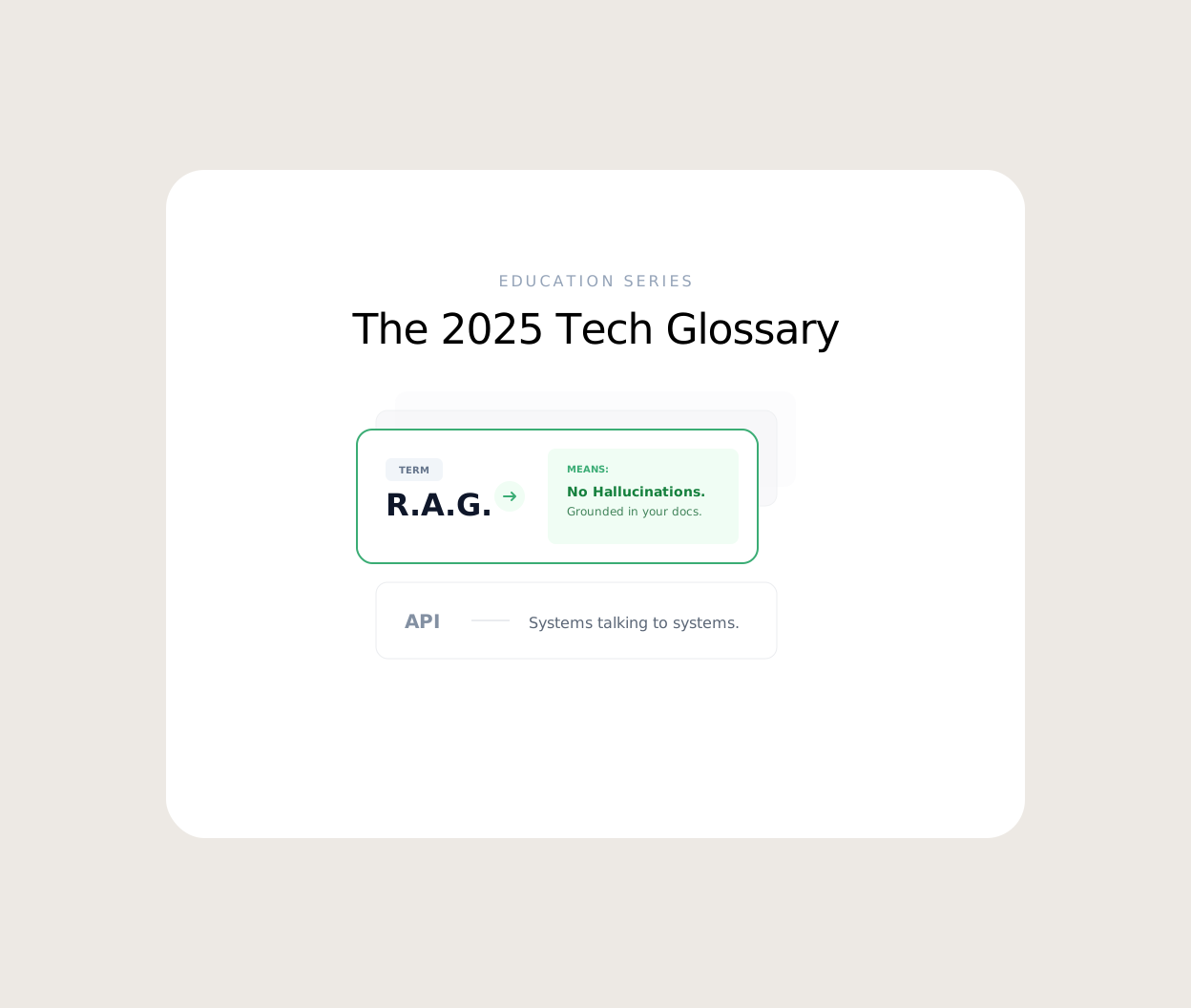
Retrieval Augmented Generation (RAG): This is a critical term for brokers. RAG combines the generative power of an LLM with a specific, proprietary knowledge base. Instead of answering a query based on its general training, a RAG system first retrieves relevant information from your documents (e.g., a specific policy wording on your server) and then uses an LLM to generate an answer based only* on that retrieved information. This greatly reduces 'hallucinations' (incorrect AI output) and ensures answers are grounded in your firm's specific data. Cluda's AI Assistant uses RAG to answer queries directly from your uploaded policy documents within your Client Environment.
API (Application Programming Interface): An API allows different software applications to communicate and share data. This is how platforms like Acturis or OpenGI might 'talk' to Cluda, enabling data exchange and automating workflows without manual input. Cluda offers robust API Integrations to connect with your existing systems.
Tokenisation: In the world of LLMs, text is broken down into smaller units called 'tokens' before processing. These can be words, parts of words, or characters. The cost and performance of LLMs often relate to the number of tokens processed.
Hallucination: When an AI model generates incorrect, fabricated, or nonsensical information, presenting it as fact. RAG systems are designed to minimise hallucinations by grounding AI responses in verifiable data, crucial for insurance document accuracy.
Prompt Engineering: The art and science of crafting effective inputs (prompts) for LLMs to get the desired output. A well-engineered prompt for an AI Assistant will yield a much better summary or comparison than a vague one.
Generative AI for Insurance Compliance: Why These Terms Matter
Understanding these concepts isn't just academic. It directly impacts your firm's operational efficiency, risk management, and client service. When exploring generative AI for insurance compliance, this knowledge is paramount.
When you hear about 'AI policy comparison', knowing about RAG helps you understand that the system isn't just guessing; it's retrieving specific clauses from your Policy Comparison documents and presenting them for your review. When discussions turn to 'automating renewal reports', knowing about APIs illustrates how data flows into your Renewal Reports templates, rather than needing manual copying and pasting. This knowledge allows you to engage constructively with new technology, avoiding generic 'solutions' that do not meet your specific needs in the UK insurance market.
Equipping Your Team for the Future
The future of commercial insurance broking involves technology, but it doesn't mean brokers become irrelevant. It means you will have better tools. A basic grasp of these terms equips you to make informed decisions, protecting your firm from technology risks whilst enhancing your competitive edge. It's about working smarter, not just harder.
Ready to stop the manual grind? Start your 14-day free trial or Book a Demo.
Frequently Asked Questions
Is ChatGPT safe for UK insurance brokers to use with client data?
No. Public Large Language Models (LLMs) like ChatGPT are not secure for client policy data. Pasting sensitive information into them puts your firm at significant E&O risk and can lead to GDPR breaches, as your data might be used for training these widely accessible models. Always use purpose-built, secure AI solutions for sensitive information.
How does RAG improve AI accuracy for insurance documentation?
RAG (Retrieval Augmented Generation) improves AI accuracy by ensuring the AI's responses are based on your specific, verified internal documents, rather than its general training data. It retrieves exact passages from your policies or wordings first, then generates an answer, significantly reducing 'hallucinations' and ensuring accuracy for legal and compliance needs within a broking house.
What is the key difference between AI and Machine Learning in broking operations?
AI is the broader concept of machines performing tasks that emulate human intelligence. Machine Learning (ML) is a subset of AI where systems learn from data without being explicitly programmed. All ML is AI, but not all AI is ML. For insurance, ML might predict claims trends, while a full AI system might automate parts of the underwriting process or handle complex queries regarding unstructured data.