A Practical Guide to AI adoption for insurance brokers
How brokers can delegate real work to AI without losing verification, traceability or accountability.

Allan Cândido
Marketing Executive, Cluda

The Bank of England and FCA's 2024 survey found 75% of respondent firms were already using AI, with insurance the highest-adopting sector surveyed, at 95%. But the survey measured whether a firm had any AI use case at all, not whether its operating model had actually changed. For many independent brokerages, usage and adoption are not the same thing.
The real measure is how much real work a firm can safely delegate, how reliably that work gets checked, and how clearly responsibility stays with the broker. Access to a tool tells you almost nothing about any of that.
A framework mapping how software teams adopt AI, published by Boris Cherny, Head of Claude Code at Anthropic, spread quickly across LinkedIn and X this year. It maps four stages, measured by how many AI agents an engineer runs at once, a useful measure for a software team, not for a broking firm. What matters here is how much work has actually moved from a person to a system, how it gets checked, and who stays accountable when something goes wrong. Broking also needs a stage the original doesn't include: Gated, the stage before formal adoption begins.
Every new level of delegation requires a new level of control. That's the rule behind the five stages below.
What AI adoption actually means in a broking firm
Whether a firm "uses AI" depends on four separate things: usage, who has access to a tool, the easiest thing to measure and the least useful; delegation, what work has actually moved from a person to a system; trust, built by a system proving its outputs are traceable back to source, not by a vendor's marketing; and responsibility, which never moves.
The FCA relies on existing frameworks, Consumer Duty, SM&CR and governance and controls, rather than AI-specific regulation, and using AI never transfers regulatory accountability to the tool or its provider. A firm's real stage of adoption is the answer to all four at once.
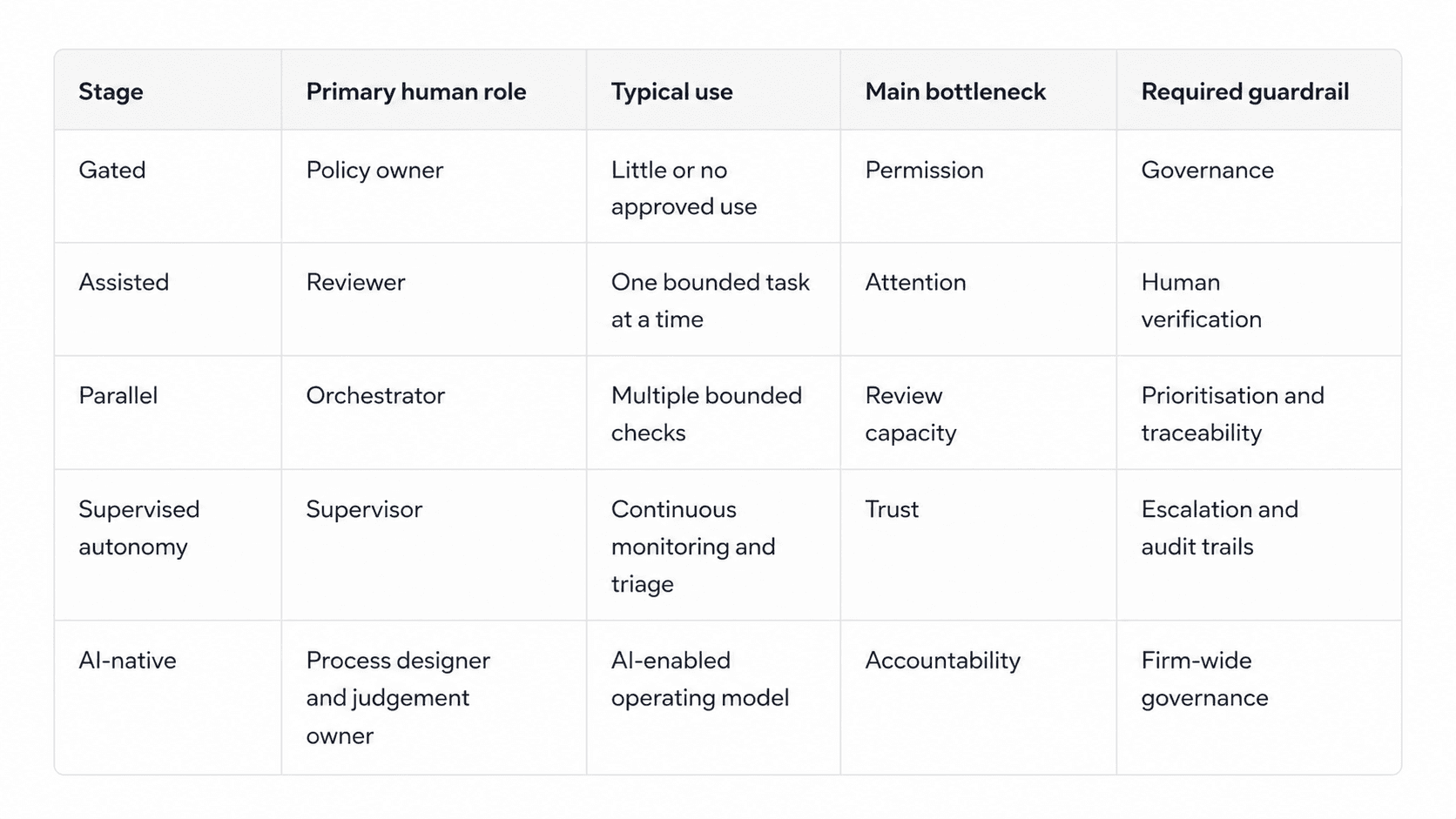
The five stages of AI adoption for insurance brokers
Stage 0 — Gated. Little or no approved AI use, usually over data or compliance concerns, or because nobody owns the decision. This often just pushes use underground, with staff experimenting on personal accounts instead of on anything the firm has actually agreed to.
Stage 1 — Assisted. One broker, one tool and one task at a time: summarising a wording, drafting an email or comparing a schedule against a proposal, with every line checked manually. This is likely where much of current adoption sits. The risk is mistaking speed for reliability under time pressure.
Stage 2 — Parallel. Several bounded checks run at once across a book: comparing insurer proposals, flagging wording differences, spotting endorsement changes. The bottleneck shifts from doing the work to prioritising what gets reviewed first.
Stage 3 — Supervised autonomy. Systems monitor documents and processes continuously. A wording change is compared automatically against the previous version, a discrepancy is sent directly to the account handler, and exceptions are routed to a person without waiting for someone to initiate the check. This only works with a genuine audit trail and clear escalation rules. Without them, a firm cannot account for what its own system did.
Stage 4 — AI-native. Processes are designed around what people and systems each do best, not AI bolted onto old workflows. The risk is accountability quietly drifting as automation grows, unless it's actively maintained.
The five stages at a glance
How to start safely
Begin with a usage policy: named ownership, a short list of approved tools, and explicit rules on what client data can go into them. Every personal-data processing operation needs a defined purpose and lawful basis, established before processing begins, with additional requirements where special category data is involved. Outputs need to be traceable back to their source document and logged: what was checked, when, and what a human did about it. Whatever the stage, final advice, material coverage recommendations and client negotiations stay human-owned.
A good first use case is frequent, easy to verify against a source document and low-consequence enough that an error will be caught before it reaches a client. Wording comparisons and schedule checks often fit those criteria; open-ended client conversations do not. Before choosing a vendor, ask whether client data is retained or used to train the model, whether access can be restricted by role, whether outputs link back to source clause by clause, and whether there's a complete, exportable audit log.
Days 1–30: Usage policy, a named owner, one or two bounded use cases.
Days 31–60: A controlled pilot, tracked against manual verification time.
Days 61–90: An honest review, and a documented decision to scale, adjust or stop.
That documented decision is worth as much as the pilot itself if the same question comes up again in a year.
The goal is not maximum automation
Reaching Stage 4 isn't the objective for every firm. A small brokerage can get real value sitting at Assisted or Parallel, depending on the work and how much supervision capacity it actually has. The honest way to measure progress isn't logins or prompt counts, but how much manual work the same result would have taken without the tool, and whether the firm can still explain how it got there months later.
The goal, at every stage, is reliable delegation: work that has genuinely moved from person to system, checked in a way that holds up under scrutiny, with responsibility never in doubt about where it sits. Every new level of delegation requires a new level of control. Firms that treat that as the rule, not the caveat, are the ones that will still be able to explain their AI use with confidence in two years' time.
What's the difference between AI usage and AI adoption for a broking firm?
Usage is whether people have access to a tool. Adoption is how much real work has actually moved from a person to a system, how reliably that work gets checked, and how clearly responsibility stays with the broker. A firm can have high usage and still be stuck at Gated or Assisted if none of that has changed.
Does the FCA require brokers to have a specific AI policy?
There's no AI-specific FCA rulebook for brokers. Existing obligations still apply. Where AI affects client communications, recommendations or understanding of cover, firms still need to meet expectations under frameworks such as Consumer Duty and SM&CR.
What's the main risk of moving to the next stage too quickly?
Skipping a stage means running on a system nobody has properly tested. A firm that jumps from a few people experimenting with ChatGPT straight to automated monitoring has no real basis for trusting what it's built, because the review discipline and audit trail that make that trust possible were never put in place.
Can client data go into any AI tool a broker chooses?
Not by default. Each use of personal data needs its own lawful basis and defined purpose, agreed before processing starts, with extra care for special category data and a data protection impact assessment for higher-risk uses.